Phone / Whatsapp:+8615618993196

Views: 0 Author: Site Editor Publish Time: 2026-09-08 Origin: Site


Inefficient inventory management drains project margins. Damaged copper piping, tangled wire spools, and extended retrieval times kill daily productivity in the warehouse and on the job site. Standard pallet racking systems fail when handling the specific inventory profile of electrical contracting. These traditional systems are built for uniform, palletized loads. They cannot handle the long, heavy, and awkwardly shaped materials that dominate electrical supply yards. To eliminate vertical obstructions and achieve high-density storage, facility managers must transition to structural solutions designed specifically for their inventory. Implementing open-faced, highly accessible frameworks allows for unobstructed loading and unloading of cumbersome items. Understanding the technical specifications required to evaluate, specify, and procure the correct system is the first step in optimizing an electrical supply distribution center. Upgrading your storage infrastructure directly reduces material damage and accelerates load-out times for your field crews.
Purpose-Built Design: Cantilever systems eliminate vertical obstructions, making them the only viable structural solution for long material storage racks handling 10-to-20-foot conduit and strut channels.
Load Profiling is Critical: Specifying the correct system requires exact calculations of arm capacity, upright capacity, and load deflection limits to prevent structural failure under heavy copper or steel loads.
Customization Drives Efficiency: Integrating specialized components like spool axles transforms standard frames into dedicated cable storage racks, maximizing vertical warehouse space.
Vendor Due Diligence: Partnering with a certified custom storage rack manufacturer ensures compliance with local seismic codes, concrete slab load-bearing requirements, and long-term structural integrity.
Success in electrical material storage relies on strict criteria: rapid accessibility, absolute damage reduction, maximized space utilization, and accelerated picking speed. When warehouse infrastructure fails to meet these criteria, labor hours inflate. Standard pallet racks force warehouse personnel to navigate around fixed vertical uprights. This structural limitation creates a bottleneck for every inbound shipment and outbound pick, directly reducing the volume of material a facility can process per shift. You cannot force 20-foot lengths of pipe into a system designed for 48-inch pallets without sacrificing efficiency.
Rigid metal conduit (RMC), PVC piping, and galvanized strut channels typically arrive in 10-foot or 20-foot bundles. Attempting to load these bundles into standard pallet racking requires operators to thread long materials between fixed front uprights. This threading process routinely causes impact damage to the rack structure and the inventory. Scratched conduit coatings and bent strut channels lead to material rejection on the job site. Furthermore, the restricted access creates severe safety hazards, as forklift operators must perform complex, multi-point turns to angle long loads into confined pallet bays.
Using standard pallet racks for long electrical materials triggers a cascade of operational failures:
Operators waste time maneuvering forklifts at severe angles to bypass front uprights.
Forks scrape against the rack frames, compromising the structural integrity of the steel.
Long bundles bow in the center due to inadequate horizontal support across the pallet beams.
Manual pickers struggle to extract single pieces of conduit from tightly packed, obstructed bays.
Heavy wire spools present a unique spatial challenge. Storing these cylindrical loads on standard wooden pallets often leads to rolling risks and uneven weight distribution. Floor stacking spools consumes massive amounts of premium square footage and creates a chaotic, inaccessible footprint. When a specific gauge of wire is needed from a floor-stacked arrangement, operators must move multiple unrelated spools to reach the target item. This spatial waste and the resulting retrieval bottlenecks paralyze warehouse throughput during peak morning load-outs.
Standard racks force workers into awkward, non-ergonomic positions. Extracting a single stick of conduit from a bundled pallet deep inside a standard rack requires vertical lifting and horizontal pulling simultaneously. This manual picking friction increases the risk of musculoskeletal injuries. Conversely, the horizontal, open-face design of cantilever systems allows warehouse staff to approach the load directly. Workers can perform rapid, ergonomic manual picking of smaller conduit bundles or individual strut channels without navigating around steel uprights.
The structural foundation of any cantilever system dictates its maximum capabilities. Uprights are anchored to the floor via heavy-duty bases, creating the vertical spine of the rack. For electrical contractors handling dense weight, the choice between roll-formed steel and structural steel dictates the safety of the entire facility. Roll-formed steel is manufactured by cold-rolling flat coil steel into a tubular shape, suitable for medium-duty applications like PVC and lightweight EMT. Structural steel, formed from hot-extruded C-channels or I-beams, offers vastly superior impact resistance and load-bearing capacity, making it mandatory for storing heavy RMC, thick-walled copper, and large cable spools.
| Feature | Roll-Formed Steel Racks | Structural Steel Racks |
|---|---|---|
| Manufacturing Process | Cold-rolled from flat coil steel | Hot-extruded C-channels or I-beams |
| Impact Resistance | Moderate (susceptible to forklift damage) | High (withstands heavy industrial impacts) |
| Ideal Electrical Inventory | PVC piping, EMT, lightweight trays | RMC, heavy copper, massive wire spools |
| Upfront Investment | Lower initial material cost | Higher initial material cost |
| Fastening Method | Pin or teardrop connections | Heavy-duty bolted connections |
Arms extend horizontally from the uprights to support the inventory. Straight arms are typically used for flat, stable loads like bundled strut channels or sheet metal. However, when configuring pipe storage racks, straight arms present a rolling hazard. Inclined arms, pitched slightly upward at the tip, use gravity to keep cylindrical materials like PVC and copper piping seated securely against the upright. Alternatively, straight arms can be fitted with welded or removable end-stops (pipe stops) to prevent loose conduit from rolling off the front edge during forklift interaction.
Horizontal and diagonal bracing panels connect the vertical uprights, creating a rigid, unified structure. This bracing does not bear the load of the inventory; rather, it provides essential lateral stability. When a forklift places a heavy bundle of steel conduit onto the arms, the rack experiences dynamic loading forces. Proper bracing prevents rack sway and longitudinal collapse. The spacing and configuration of the bracing dictate the distance between uprights, which must be engineered to match the specific length and deflection characteristics of the stored materials.
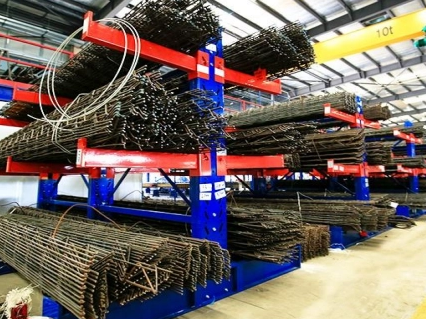
Specifying long material storage racks requires rigorous mathematical evaluation. Capacity is divided into two distinct metrics: arm capacity and upright capacity. Arm capacity assumes a Uniform Distributed Load (UDL). If an arm is rated for 2,000 lbs, the load must sit evenly across the entire length of the arm. Point-loading a heavy item at the very tip of the arm will cause structural failure, even if the item weighs less than 2,000 lbs. Total upright capacity is the maximum weight a single vertical column can support across all its attached arms, factoring in the weight of the arms themselves.
Warehouse managers must also account for load deflection. When storing 20-foot lengths of flexible material like small-diameter PVC or threaded rod, the distance between the uprights must be tight enough to prevent the material from sagging in the middle. If the bracing spaces the uprights too far apart, the material will bow, creating an unstable load that is dangerous to lift and prone to permanent deformation.
A cantilever system is only effective if material handling equipment can safely interact with it. The relationship between aisle width, forklift turning radius, and arm length is absolute. Standard sit-down counterbalance forklifts require exceptionally wide aisles (often 12 to 14 feet) to approach the rack perpendicularly. Multi-directional reach trucks or side-loaders can operate in much narrower aisles, as they travel parallel to the rack while carrying long loads. Facility managers must calculate the aisle width by adding the length of the longest stored material to the minimum turning radius of the specific forklift fleet.
The physical location of the rack dictates the required steel finish. Indoor, climate-controlled warehouses generally utilize powder-coated finishes. Powder coating provides a durable, highly visible surface that resists standard warehouse abrasions. However, electrical contractors frequently store bulk conduit and weatherproof components in outdoor yards. For outdoor applications exposed to rain, snow, and UV radiation, powder coating will rapidly degrade, leading to structural rust. Outdoor racks require hot-dipped galvanized steel, where the components are submerged in molten zinc to provide total, long-lasting corrosion resistance.
Standard cantilever frames can be modified to handle the dynamic requirements of wire dispensing. By integrating specialized drop-in axles and heavy-duty brackets across the arms, standard frames become dedicated cable storage racks. This configuration allows massive spools of THHN, Romex, or heavy feeder cable to be stored vertically. More importantly, it allows warehouse staff to pull and cut wire directly from the rack without removing the spool with a forklift. This transforms static storage into an active, high-capacity processing station.
When designing these dispensing stations, the axle diameter and bracket strength must align with the maximum weight of a fully loaded wooden reel. A 5,000 lb reel of commercial feeder cable requires structural steel arms and solid steel axles to prevent the dispensing mechanism from bending under the rotational friction generated during a wire pull.
When storing various types of metal piping, chemical interactions must be managed. High-density configurations are engineered to separate different diameters and material compositions. Placing raw steel pipe directly against copper tubing can induce galvanic corrosion over time, especially in humid environments. Specialized rack configurations utilize heavy-duty dividers or designated arm levels with protective polymer sleeves to isolate copper from steel. This ensures material integrity while maintaining high-density organization.
Electrical contractors do not only stock long materials; they also manage bulky, awkwardly shaped items like large junction boxes, commercial transformers, and heavy steel panel boards. Hybrid storage solutions address this by adding wire mesh decks or solid steel decking across the cantilever arms. This creates continuous, heavy-duty shelving without front upright obstructions. Decked cantilever racks for electrical contractors allow forklifts to place oversized, non-palletized equipment anywhere along the shelf level, maximizing flexibility for unpredictable inventory profiles.
Warehouse verticality must be exploited to its maximum safe limit. Multi-tiered systems are engineered to handle mixed inventory profiles within the same footprint. Heavy, bulk items—such as massive reels of underground feeder cable or dense bundles of RMC—are stored directly on the reinforced lower bases. The mid-level arms are utilized for medium-weight materials like strut channels and EMT. The uppermost arms are reserved for lighter inventory, such as PVC piping, cable trays, and commercial lighting fixture housings. This strategic weight distribution maintains a low center of gravity while optimizing every inch of vertical space.
Procurement teams face an immediate choice between standard catalog racks and custom-engineered systems. Standard off-the-shelf racks offer faster lead times and lower upfront costs, making them suitable for lightweight, predictable inventory like PVC. However, electrical contractors dealing with extreme weights or unique spool dimensions benefit significantly from partnering with a custom storage rack manufacturer. Custom manufacturers provide tailored arm lengths, specific load engineering, integrated spool holders, and exact upright spacing designed around the contractor's specific material handling equipment.
A custom manufacturer will also evaluate your specific workflow. If your facility processes a high volume of daily wire cuts, they can engineer a continuous row of dispensing axles at ergonomic heights, keeping your warehouse staff off ladders and reducing manual lifting fatigue.
The secondary market for warehouse equipment is vast, but purchasing used cantilever racks introduces severe operational risks. Used racks often suffer from unknown steel fatigue, hairline weld fractures, and undocumented impact damage. Furthermore, used systems rarely come with original engineering stamps or load capacity guarantees. Investing in a new system from a reputable cantilever rack manufacturer guarantees structural integrity, provides accurate load ratings, and ensures the facility is protected by comprehensive warranties and liability coverage.
Structural failure in a high-capacity rack system is catastrophic. Procurement must demand stamped engineering drawings for any proposed system. The manufacturer must adhere to strict guidelines established by the Rack Manufacturers Institute (RMI). Furthermore, local seismic zone compliance is non-negotiable. Facilities located in seismically active regions require heavily modified racks with oversized base plates, thicker upright steel, and reinforced bracing to withstand lateral ground acceleration. A certified manufacturer will engineer the system specifically for the zip code of the installation site.
Evaluating vendor reliability extends beyond the initial purchase order. Contractors must assess the availability of replacement parts, as forklift impacts will inevitably damage arms over time. Examine the warranty terms specifically regarding structural welds and steel deflection limits. Realistic delivery timelines must be established, as custom-engineered structural steel systems often require extensive fabrication periods. A reliable manufacturer provides ongoing lifecycle support, including rack inspection guidelines and readily available expansion components as the contractor's business scales.
The most robust cantilever rack will fail if the concrete floor beneath it collapses. Heavy-duty uprights exert massive point loads onto the warehouse slab. Before installation, facility managers must conduct core testing to verify slab thickness and concrete compressive strength (PSI). If the slab is insufficient, the concrete will crack, causing the rack to lean and potentially collapse. Mitigation requires engineering oversized base plates to distribute the weight over a larger surface area, or in extreme cases, pouring new, reinforced concrete footings specifically for the rack bases.
Undersizing aisles for long-load handling is a frequent and costly error. If an aisle is too narrow, forklift operators cannot square up to the rack, leading to oblique loading angles that damage the arms and risk dropping the material. Mitigation involves utilizing 3D warehouse modeling software during the planning phase. Facility managers must conduct a strict review of forklift specifications, mapping the exact turning radius against the length of a 20-foot conduit bundle to guarantee safe, obstruction-free maneuvering.
Even perfectly engineered racks are vulnerable to human error. Point-loading creates excessive leverage that can snap the arm or pull the upright forward. Mitigation requires strict warehouse protocols and comprehensive operator training. Forklift drivers must follow specific loading procedures to maintain rack integrity.
Always seat the load as far back against the vertical upright as possible.
Ensure long bundles are supported by an adequate number of arms to prevent bowing.
Never exceed the Uniform Distributed Load (UDL) rating of a single arm.
Place the heaviest materials on the base or lower arms to maintain a low center of gravity.
Conduct weekly visual inspections of all arms and uprights for signs of forklift impact damage.
Transitioning to cantilever racks is a required structural upgrade for electrical contractors aiming to scale their operations. By eliminating vertical obstructions, these systems drastically improve picking efficiency, reduce material damage, and maximize vertical space utilization. The unique inventory profile of electrical supply demands a purpose-built storage environment that standard pallet racking simply cannot provide.
The decision to procure a system must be filtered through strict technical criteria. Facility managers must evaluate load weights, material lengths, and environmental conditions to determine the correct steel type and finish. Navigating the risks of the used market and understanding when to leverage a custom manufacturer ensures the final installation is safe, compliant, and optimized for the specific workflow of the yard or warehouse.
Audit your current inventory to identify the exact lengths, weights, and diameters of your most difficult-to-store materials.
Measure your facility's concrete slab thickness and verify the compressive strength rating to ensure it can support structural uprights.
Calculate your required aisle widths based on your specific forklift turning radius and your longest conduit bundles.
Request stamped engineering drawings and load calculations from a certified manufacturer before approving any purchase order.
A: Capacity varies significantly based on the engineering and materials used. Roll-formed steel arms typically support between 1,000 and 2,000 lbs each. Structural steel systems, designed for heavy electrical materials, can be engineered to support 5,000 lbs or more per arm, depending on the arm length and upright specifications.
A: Yes, but they require specific environmental protection. Outdoor racks must be manufactured with a hot-dipped galvanized finish to prevent rust and corrosion from weather exposure. Installing structural canopies over the racks is also highly recommended to protect sensitive inventory from direct rain and UV damage.
A: Standard cantilever frames can be converted into dispensing stations using specialized drop-in spool axles and heavy-duty brackets. These brackets secure the axle across two arms, allowing the wire spool to spin freely. This setup enables workers to pull and cut cable directly from the rack without moving the spool.
A: Roll-formed racks are made from cold-rolled sheet metal, offering a cost-effective solution for lighter loads like PVC. Structural racks are built from hot-extruded C-channels or I-beams. Structural steel provides superior impact resistance and massive weight capacity, making it the required choice for heavy electrical materials like RMC and copper.
A: The required aisle width is determined by adding the length of your longest stored material to the minimum turning radius of your forklift, plus a 12-to-18-inch safety clearance margin. Standard counterbalance forklifts require much wider aisles than specialized multi-directional reach trucks.
A: Off-the-shelf racks work for standard, lightweight inventory. However, a custom manufacturer is necessary if you require specific load engineering for extreme weights, unique spool axle integration, decked hybrid storage levels, or if your facility is located in a high-risk seismic zone requiring specialized structural compliance.
A: Buying used racks carries significant risks. Used systems often lack original engineering stamps, seismic certifications, and documented history. Hidden metal fatigue or hairline weld fractures from previous forklift impacts can lead to catastrophic failure under the heavy loads typical of electrical contracting inventory.


