Phone / Whatsapp:+8615618993196

Views: 0 Author: Site Editor Publish Time: 2026-07-15 Origin: Site


Industrial real estate costs sit at an all-time premium, making maximum volume utilization a critical operational mandate rather than a secondary goal. Warehouse operators face a constant battle to increase storage density without creating severe bottlenecks in material handling workflows, reducing throughput speed, or compromising inventory integrity through product expiration or pallet damage. Standard selective racks waste massive amounts of floor space on forklift aisles. To solve this, facilities turn to deep-lane storage solutions. While both drive-in and drive-through systems eliminate standard forklift aisles to create high density pallet racking environments, their structural designs dictate entirely different inventory management methodologies. This guide evaluates the technical specifications, structural engineering differences, operational trade-offs, and implementation realities of both systems. By understanding the mechanical limitations and workflow requirements of each configuration, warehouse managers can align their infrastructure directly with their inventory rotation needs.
Inventory Flow Dictates Architecture: Drive-in pallet racking relies on a single access point, strictly enforcing a Last-In, First-Out (LIFO) model. Drive-through racking utilizes dual access points, enabling a First-In, First-Out (FIFO) model.
Density vs. Selectivity: Both systems sacrifice individual pallet selectivity for maximum storage density, resulting in a low pick face profile where multiple pallet positions are dedicated to a single SKU. Drive-in systems offer a slightly higher theoretical density yield due to requiring fewer operational aisles.
Structural Bracing Differences: Drive-in systems utilize rear diagonal bracing for stability, whereas drive-through systems require specialized top-ties or overhead bracing to maintain structural integrity while keeping both entry and exit points unobstructed.
Traffic Flow and Throughput: Drive-through configurations reduce forklift congestion and increase cycle times by separating the loading and unloading zones, while drive-in setups can cause localized bottlenecks.
Risk Profile: Both systems require forklifts to enter the rack structure, necessitating rigorous operator training, specialized material handling equipment (MHE), and robust structural protection to mitigate collision risks and pallet deflection.
Deep-lane storage fundamentally changes how a warehouse operates. Both systems utilize continuous lanes of stationary storage where pallets rest on continuous rails, often called support ledges, rather than individual step beams. This structural choice eliminates the need for intermediate aisles between every rack row. By removing these aisles, facilities can compress their storage footprint, often doubling the amount of pallet positions available in a given square footage compared to standard selective racking.
However, this density comes with a strict operational trade-off known as the low pick face reality. Because pallets sit in deep, continuous lanes—sometimes up to ten or fifteen pallets deep—only the frontmost pallet in each lane remains immediately accessible to a forklift operator. You lose the ability to pick any pallet at any time. This results in significantly fewer active picking faces. Warehouse managers must dedicate entire lanes to a single SKU to prevent burying different products behind one another, which would require massive, inefficient restacking operations to retrieve the blocked goods.
The core divergence between the two systems lies in their entry and exit points. This is not merely a layout preference; it is a rigid structural decision that permanently locks a facility into specific inventory management frameworks and forklift traffic patterns. The choice dictates whether your operators will drive in and back out, or drive through from one end to the other, fundamentally altering cycle times and warehouse traffic flow.
To fully grasp the mechanics, you must look at the rail design. The rails must support the entire weight of the pallet along its edges. This requires high-quality, standardized pallets. If a pallet is damaged, missing bottom boards, or slightly undersized, it risks deflecting or slipping off the rails entirely, creating a severe safety hazard. The engineering tolerances inside these systems are incredibly tight, leaving very little room for operator error or equipment variation.
Drive-In Pallet Racking operates on a single-aisle access model. Operators drive their material handling equipment directly into the storage lane to place a pallet on the rails. Once the pallet is deposited, the operator must reverse the forklift and back out from the exact same entry point. This maneuver requires precision, excellent visibility, and specific training, as driving backward out of a narrow, dark rack lane increases the risk of mast collisions with the upright frames.
From a structural engineering standpoint, drive in pallet racking achieves its necessary rigidity through heavy-duty back-diagonal bracing. Because the back of the system is closed to traffic, engineers can install massive steel cross-braces across the rear frames. Additionally, ground-level pallet backstops are installed at the end of each lane. These physical barriers prevent operators from accidentally pushing a pallet out the back of the system and stop forklifts from attempting to drive all the way through.
This closed-back structure inherently forces a Last-In, First-Out inventory flow. The first pallet loaded into a lane gets pushed to the very back. It cannot be accessed or retrieved until every single pallet loaded in front of it is removed. This LIFO pallet racking reality presents a high risk of product obsolescence for dated goods. If you store perishable items here, the oldest stock remains trapped at the back of the lane while newer stock is continuously picked from the front.
Implementing this system requires careful consideration of your product mix. It excels in specific environments but fails completely in others. You must analyze your SKU velocity and batch sizes before committing to a LIFO structure.
Analyze SKU homogeneity: Ensure you have large quantities of identical products to fill deep lanes without mixing SKUs.
Verify shelf life: Confirm that the stored goods are non-perishable or have an indefinite shelf life to avoid expiration at the back of the lane.
Evaluate cold storage needs: Use this system in freezer environments where maximizing cubic space directly reduces refrigeration energy consumption.
Assess batch shipping: Ideal for staging large orders where an entire lane will be emptied and shipped at once.
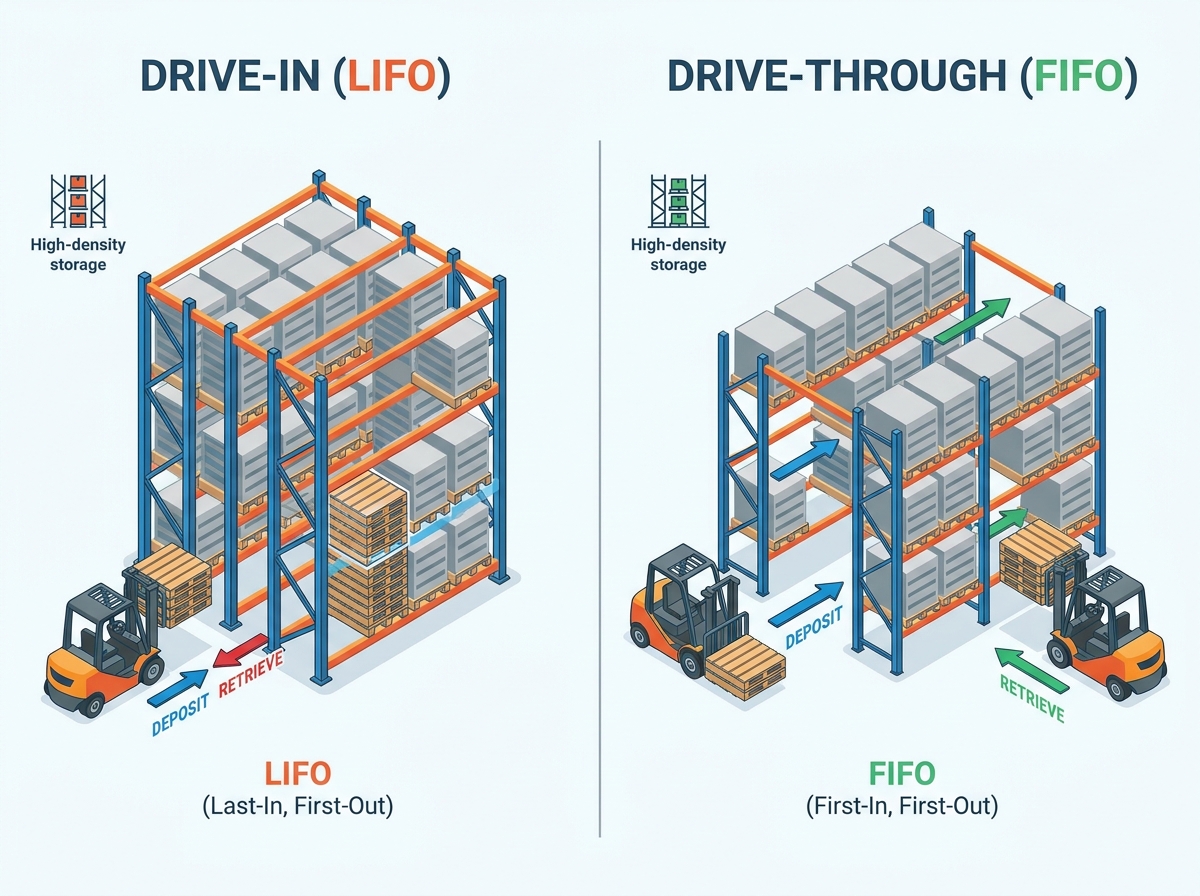
Drive through racking utilizes a dual-aisle access model, fundamentally changing the traffic pattern of the warehouse. Operators can load pallets from one side of the system, designated as the loading face, and retrieve them from the opposite side, known as the unloading face. This separation of tasks allows for a continuous flow of goods from receiving to shipping without forklifts crossing paths in the same aisle.
The engineering challenge of these systems is significant. Because both ends of the lane must remain completely open for forklift entry and exit, traditional rear diagonal bracing is impossible. To maintain structural integrity and prevent the massive steel frames from swaying or collapsing under heavy loads, engineers must use overhead top-tie bracing systems. These heavy steel beams connect the upright frames across the top of the structure, tying the entire block together. This overhead bracing must be carefully designed to ensure it clears the maximum mast height of the forklifts operating within the lanes.
This open-ended design is what enables FIFO pallet racking management. By loading on one side and picking from the other, the oldest stock (the first pallet put in) is always the first one available at the picking face. This strict rotation is absolutely critical for date-controlled goods, preventing spoilage and ensuring compliance with industry regulations regarding product expiration.
Separating the loading and unloading zones also provides massive benefits for warehouse throughput. It eliminates forklift cross-traffic, drastically reducing congestion in busy facilities. Loaders can continuously fill lanes from the receiving dock while pickers simultaneously pull stock for outbound shipping on the opposite side. This parallel workflow maximizes stock rotation speeds and keeps material handling equipment moving efficiently.
| Operational Metric | LIFO Configuration | FIFO Configuration |
|---|---|---|
| Stock Rotation | Poor (Oldest stock trapped) | Excellent (Oldest stock picked first) |
| Traffic Congestion | High (Single aisle for load/unload) | Low (Separate load/unload aisles) |
| Ideal Product Type | Hardware, building materials, long shelf-life | Food, beverage, pharmaceuticals |
| Throughput Speed | Slower (Requires backing out) | Faster (Continuous forward motion possible) |
When evaluating these two high-density options, footprint and layout requirements dictate the initial feasibility. Drive-in configurations require only one operational forklift aisle to access the storage block. This maximizes the absolute cubic volume of storage within a given footprint. Conversely, drive-through configurations require two operational aisles—one at the front and one at the back. This consumes more total floor space, slightly reducing the total storage volume capacity compared to a closed-back system. You trade a percentage of raw density for the operational benefits of dual access.
Both systems suffer from the honeycombing effect, a critical factor in calculating actual versus theoretical storage capacity. Honeycombing occurs when empty pallet positions inside a lane cannot be utilized because that lane is dedicated to a specific SKU, and mixing SKUs would block access to the rear pallets. If a lane holds ten pallets, and you only have six pallets of that SKU in stock, four positions remain empty and unusable. Drive-through setups are slightly more susceptible to severe honeycombing if SKU rotation rates are mismatched between the loading and unloading faces, leading to partially filled lanes that span the entire depth of the rack.
Throughput speed and cycle times differ significantly based on the required forklift maneuvers. The drive-in backing maneuver inherently increases cycle times. Operators must drive in slowly, place the load, look over their shoulder, and reverse out of the narrow lane. This constant shifting of gears and direction slows down operations. In contrast, the dual-access nature of a FIFO setup allows for more streamlined traffic patterns, keeping loaders and pickers in their respective zones and maintaining a smoother operational rhythm.
Material Handling Equipment (MHE) compatibility is a strict constraint for both designs. Standard wide-carriage forklifts cannot enter these systems. Facilities must utilize specialized reach trucks or counterbalanced forklifts with narrow chassis. Furthermore, the overhead guard dimensions of the forklift must be carefully measured against the internal clearance of the rack lanes. If the overhead guard is too wide, it will strike the pallet support rails or the upright frames, causing catastrophic damage to the structure.
| Technical Specification | Drive-In System | Drive-Through System |
|---|---|---|
| Aisle Requirements | Single access aisle | Dual access aisles (front and rear) |
| Structural Stability Method | Rear diagonal cross-bracing | Overhead top-tie beams |
| Forklift Maneuver | Drive in, reverse out | Drive in, drive out opposite end |
| Honeycombing Risk | Moderate to High | High (requires strict lane management) |
Operating forklifts inside narrow steel structures introduces severe risks that require engineered mitigations. Pallet standardization is non-negotiable. Because pallets rest only on continuous side rails rather than full horizontal step beams, the structural integrity of the pallet itself becomes part of the racking system. Damaged, cracked, or non-standard pallets will deflect under load. If a pallet bows too much, it will slip off the support ledges and crash down through the system, potentially triggering a progressive collapse of the pallets below it. Facilities must enforce strict pallet inspection protocols, rejecting any GMA or CHEP pallet with missing bottom boards or compromised stringers before it enters the system.
Structural integrity faces constant threats from forklift impacts. Operators drive directly into the narrow bays, leaving only inches of clearance on either side of the chassis. A slight miscalculation in steering results in the forklift striking the upright frames. Over time, these repeated impacts weaken the steel, compromising the load-bearing capacity of the entire block. To mitigate this, heavy-duty baseplates must be anchored deeply into the concrete slab. Column protectors, often called deflectors, must be bolted to the floor in front of every upright. Many facilities also utilize recessed front legs, angling the bottom of the frame away from the turning radius of the forklift, and install heavy-duty floor-mounted guide rails to physically channel the forklift tires safely through the lanes.
Operator safety and visibility present ongoing challenges. The interior of a deep-lane system is dark, and visibility decreases significantly as the operator drives deeper into the structure. Placing a pallet accurately on the rails at high elevations requires extreme precision. Strict training protocols are mandatory. Operators must understand mast sway and how to approach the rack perfectly square. Facilities should equip their MHE with heavy-duty overhead guard protection to shield operators from potential falling debris. Additionally, installing optional laser guidance systems on forklift masts helps operators align the forks perfectly with the pallet support rails, reducing the risk of pushing pallets off the ledges.
Floor flatness is another critical implementation factor. Because the tolerances inside the lanes are so tight, an uneven concrete slab will cause the forklift mast to lean as it drives into the system. A mast leaning even a few degrees at the floor level translates to several inches of sway at the top of the rack, causing the forklift to strike the rails or frames. Prior to installation, a structural engineer must survey the slab to ensure it meets strict flatness and levelness specifications required for deep-lane operations.
The choice between these two high-density configurations is rarely a matter of preference. It is a strict requirement dictated by your product's shelf life, inventory rotation needs, and the facility's available footprint. Maximizing absolute density in a confined footprint with non-perishable goods points directly to a single-aisle setup. Conversely, if strict product rotation is legally or operationally required, the dual-aisle configuration is mandatory.
Conduct a comprehensive SKU velocity analysis to determine if your batch sizes are large enough to prevent severe honeycombing in deep lanes.
Measure available floor space accurately to confirm you can accommodate the dual access aisles required for a FIFO configuration.
Audit your current pallet pool to ensure all pallets meet the strict structural requirements for resting on continuous side rails without deflecting.
Consult with a structural engineer to design a system with appropriate safety tolerances, heavy-duty baseplates, and floor-mounted guide rails.
A: Drive-in racking features a single access point, enforcing a LIFO inventory flow and utilizing rear diagonal bracing for stability. Drive-through racking features dual access points, enabling a FIFO inventory flow and requiring overhead top-tie bracing to keep both ends open for forklift traffic.
A: No. The single access point strictly enforces a LIFO flow. Attempting to achieve FIFO in this setup would require massive, inefficient restacking operations, forcing operators to remove all front pallets just to access the oldest stock at the rear.
A: Because lanes are deep, operators can only access the frontmost pallet of each lane. This drastically reduces the number of available picking faces, making these systems highly inefficient for facilities managing a high variety of low-volume SKUs.
A: Drive-in systems utilize heavy-duty rear diagonal bracing across the closed back for maximum stability. Drive-through systems must remain open at both ends, requiring engineers to use specialized top-ties or overhead bracing to stabilize the frames.
A: Facilities must use counterbalanced or reach trucks with chassis dimensions narrower than the internal rack lane. These forklifts often require specialized overhead guards to protect operators and prevent the equipment from striking the internal support rails.
A: Implement robust physical safeguards including floor-mounted guide rails, heavy-duty column guards, and recessed front legs. Additionally, enforce strict pallet standardization to prevent deflection and mandate rigorous operator training for navigating narrow lanes.
A: Honeycombing occurs when partially empty lanes are dedicated to single SKUs, leaving unusable pallet positions behind them. This inefficiency significantly reduces the theoretical maximum storage density of deep-lane systems.


