Phone / Whatsapp:+8615618993196

Views: 0 Author: Site Editor Publish Time: 2026-07-22 Origin: Site


Industrial real estate costs continue to climb, putting massive pressure on warehouse managers to maximize cubic storage space without triggering physical facility expansion. You face a constant battle between storage density and inventory selectivity. When you store high volumes of homogeneous, low-turnover products, traditional selective racks waste vertical cube space and create operational bottlenecks. Facility managers often struggle to pack goods tightly without risking product damage or slowing down forklift operators.
The Drive-In Pallet Racking system offers a specialized, high-density structural solution built specifically for low-SKU, low-turnover, and high-volume inventory profiles. By stripping out standard aisles, you reclaim floor space and pack pallets deeper. This guide breaks down the technical design, structural limitations, and implementation requirements of these deep-lane systems so you can evaluate if they fit your warehouse footprint.
Inventory Flow: Operates strictly on a Last-In, First-Out (LIFO) basis, making it unsuitable for highly date-sensitive goods unless managed in strict batch rotations.
Density vs. Selectivity: Reclaims up to 80% of warehouse cubic space by eliminating standard forklift aisles, but sacrifices individual pallet accessibility (requires full pallet load selection).
Ideal Environments: The standard for cold storage facilities and freezer environments where the cost per square foot of refrigerated air is exceptionally high.
Operational Risk: Requires specialized forklift operational protocols, high operator skill for backing out of deep lanes, and robust structural protection due to the necessity of driving directly into the rack structure.
The core concept of a drive in pallet racking system is the complete elimination of traditional horizontal beams and operational aisles. Instead of resting on beams, pallets sit on continuous depth rails supported by heavy-duty upright frames. This layout allows forklifts to drive directly into the storage bays. You utilize the full depth and height of the available warehouse cube. We typically see these systems engineered to hold anywhere from four to ten pallets deep, depending on the facility's clear height and forklift capabilities. The structural design relies on the uprights and top ties to maintain rigidity since the front face remains completely open for equipment access.
Because the system uses a single entry and exit point, inventory flow follows a strict Last-In, First-Out (LIFO) protocol. The first pallet you deposit into a specific lane becomes the last one you retrieve. This physical constraint means the system only works for bulk storage where individual pallet selectivity does not matter. If you need to pick a specific pallet from the back of a lane, operators must remove every pallet in front of it. Warehouse managers must plan production runs and shipping schedules around this LIFO limitation to avoid excessive material handling and wasted labor hours.
Proper operational sequencing keeps your facility running efficiently and prevents structural damage within these deep-lane configurations. Operators must follow exact procedures.
The operator aligns the forklift squarely with the bay opening before entering.
The operator raises the pallet slightly above the continuous rail height.
The forklift enters the single-access lane and drives forward to the deepest available open position.
The operator lowers the pallet onto the internal support rails, ensuring it sits evenly on both sides.
The operator reverses straight back out of the structure without turning the steering wheel.
For unloading, the operator enters the lane, lifts the front-most pallet off the rails, and carefully backs out before lowering the load to transport height.
Operators drive directly into the storage bays, making proper equipment selection a mandatory part of the design phase. Forklift accessible racking requires specific mast width clearances and overhead guard dimensions. If your forklift is too wide, it will strike the upright frames or support arms. Safe entry and exit speeds must be strictly enforced. We recommend using forklifts with side-shift capabilities to help operators center the pallets on the rails without needing to reposition the entire truck inside the narrow bay.
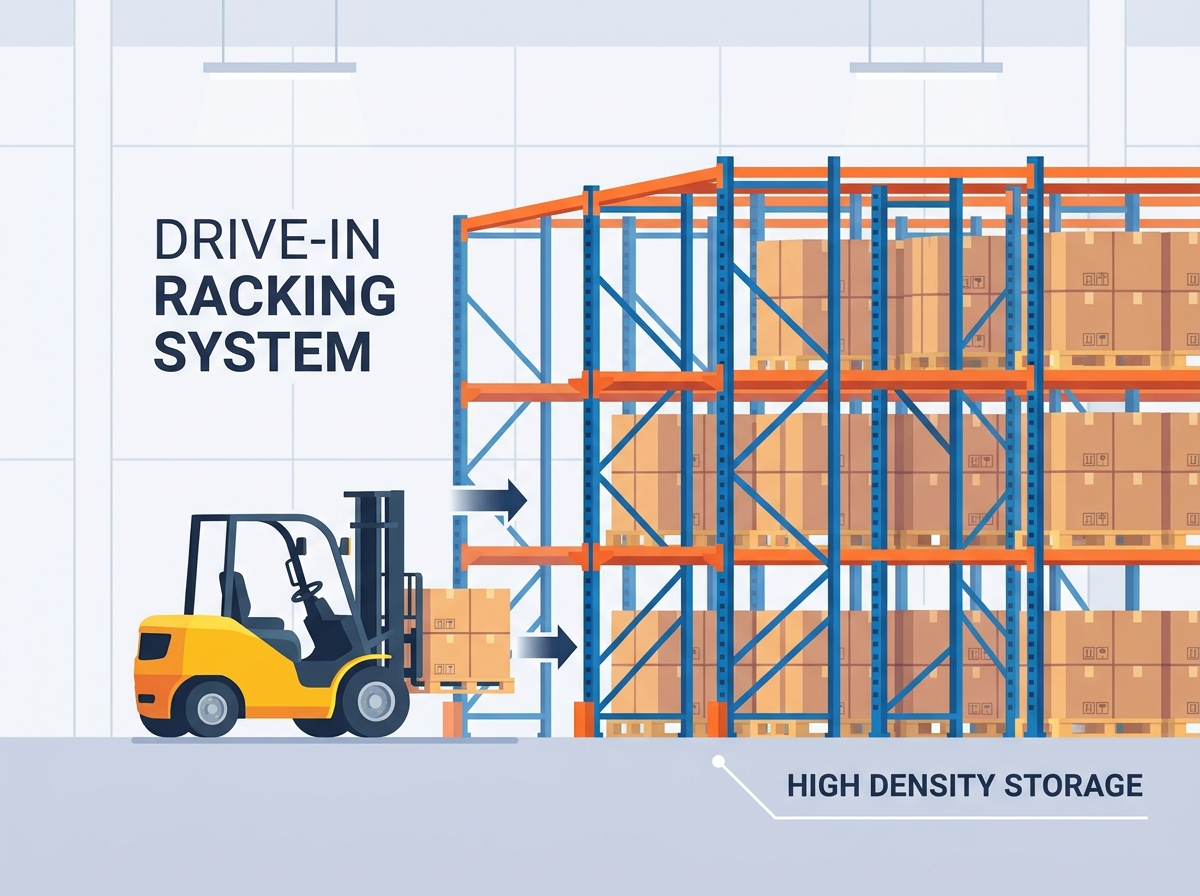
The vertical load-bearing structures take a beating. They must withstand massive static weight and continuous operational impact from forklifts. Heavy-duty, seismic-rated baseplates anchor the uprights securely to the concrete slab. These baseplates distribute the load and absorb operational shocks. When engineering the uprights, we look at the total vertical height utilization and the seismic zone of the facility. Thicker steel gauges and reinforced post profiles are standard requirements to prevent buckling under heavy loads.
Continuous rails hold the pallets deep within the structure. Heavy-duty cantilevered arms connect these rails to the upright frames. The engineering behind these components ensures they support uniform load weights across the entire depth of the bay. If the arms deflect or the rails bend, pallets can fall through the system. We specify structural angle rails or roll-formed rails depending on the pallet weight and the expected abuse from forklift operators sliding pallets along the tracks.
Structural integrity relies entirely on proper bracing. Back cross-bracing provides essential lateral stability for closed-back configurations. Removing or modifying this bracing drastically alters the system's structural dynamics and compromises safety. Top bracing ties the uprights together across the aisles, further enhancing stability. In seismic zones, this top and back bracing network prevents the entire block of racking from swaying and collapsing during an earthquake.
Mandatory structural add-ons protect the system from daily forklift traffic. Entry guides bolt to the floor at the front of each lane. They help operators align their equipment tires as they enter the bay, physically guiding the truck and reducing the risk of impact. Column protectors shield the primary load-bearing uprights from collision damage at floor level. Replacing a damaged column protector takes ten minutes; replacing a damaged upright frame takes hours and requires unloading the entire bay.
| Component | Primary Function | Inspection Focus |
|---|---|---|
| Upright Frames | Vertical load bearing | Check for deflection, twisting, or impact damage at the base. |
| Support Arms | Connect rails to uprights | Inspect for sheared bolts or downward bending. |
| Load Rails | Support pallet weight | Look for spreading, twisting, or missing fasteners. |
| Back Bracing | Lateral stability | Ensure tension is tight and no members are bent or missing. |
The primary difference between these two systems lies in the entry points. Drive-In systems feature a single aisle entry, which strictly dictates LIFO inventory flow. Drive-Through systems utilize dual-aisle entry. Operators load pallets from one side of the block and retrieve them from the opposite side. This dual-access configuration enables First-In, First-Out (FIFO) inventory management, making it suitable for date-sensitive products that still require high-density storage.
Drive-Through systems lack rear cross-bracing because forklifts must pass entirely through the structure. To maintain lateral stability without this critical back bracing, the system requires significantly stronger top bracing, heavy-duty tie-beams, and specialized upright engineering. This makes Drive-Through structures more complex to design and install. The uprights must resist lateral forces independently, often requiring larger baseplates and heavier gauge steel to compensate for the missing rear support.
Footprint differences affect your overall storage density. Drive-Through configurations require two operational aisles—one dedicated to loading and one dedicated to picking. This dual-aisle requirement slightly reduces the overall storage density compared to a closed-back Drive-In system, which only needs a single operational aisle. You trade a percentage of your floor space for the ability to maintain FIFO inventory rotation.
Maximizing pallet positions per cubic foot offsets the massive energy, refrigeration, and construction costs associated with temperature-controlled environments. A cold storage drive in rack provides the necessary density to make these expensive facilities economically viable. When you pay a premium to keep air at sub-zero temperatures, you cannot afford to waste space on empty forklift aisles. These systems pack pallets tight, reducing thermal loss and maximizing the return on your real estate investment.
Manufacturers producing large batches of identical goods benefit heavily from this setup. Beverage distribution centers, raw material storage facilities, and warehouses handling long-shelf-life goods utilize this system to store massive quantities of uniform products. When you produce thousands of pallets of the exact same SKU, you do not need individual pallet selectivity. You just need a place to stack them safely until they ship out in full truckloads.
Products that do not require frequent or immediate individual access are perfect candidates for a high density storage rack. When inventory sits for extended periods, sacrificing selectivity for density makes operational sense. The system securely holds bulk materials, packaging supplies, or raw components until large production runs require them. You keep the floor clear and utilize the vertical cube efficiently.
Holding bulk seasonal products that ship out simultaneously renders the LIFO constraint irrelevant. Facilities can pack deep lanes with seasonal goods like holiday decorations or summer patio furniture. When the shipping window opens, operators empty entire bays at once. This strategy maximizes space utilization during the off-season and allows you to stage massive amounts of inventory without renting temporary overflow warehouse space.
Maximum floor space and vertical cube utilization by eliminating aisles.
Significantly lower cost per pallet position compared to dynamic systems like Pallet Flow or automated AS/RS.
Creates a highly organized storage block for bulk, uniform inventory.
Reduces forklift travel time when loading full bays of identical SKUs.
Zero immediate selectivity; individual pallet retrieval is impossible without moving front pallets.
Slower load cycle times due to the precision required for forklifts to drive in and back out of deep lanes.
High susceptibility to "honeycombing" which reduces actual storage capacity.
Increased risk of structural damage due to forklifts operating inside the rack structure.
Honeycombing occurs when empty pallet positions become trapped behind front-loaded pallets in a lane. This prevents new pallets from being stored in those empty slots until the front pallets are removed. Because of honeycombing, actual storage capacity rarely matches theoretical capacity. A realistic utilization rate for these systems typically hovers between 70% and 75%. Warehouse managers must actively manage lane assignments and consolidate partially empty bays to fight honeycombing and maintain high density.
Consistent, high-quality pallets are strictly necessary for this system to function safely. Unbroken bottom boards and uniform load weights prevent rail failure and load shifting. Damaged pallets or overhanging loads cause wood debris to block lanes or create severe safety hazards deep within the structure. If a pallet breaks while sitting on the rails, retrieving the spilled product and the broken wood from a deep lane is a dangerous and time-consuming nightmare.
The primary risk involves operators impacting uprights deep within the rack. Because forklifts operate inside the structure, the chances of a collision increase significantly. Robust warehouse racking design must incorporate heavy-duty components and protective accessories to mitigate this risk. We specify heavier gauge steel for the lower sections of the uprights and mandate floor-mounted entry guides to keep the forklift tires aligned with the center of the lane.
Reversing out of long, narrow bays severely limits operator visibility. Specialized training ensures operators can back out straight without clipping the uprights or support arms. Proper lighting inside the warehouse and clear lane markings assist operators during this critical maneuver. Operators must rely on their mirrors and look over their shoulders, maintaining a straight steering wheel until the forklift completely clears the rack structure.
Operational shifts must enforce strict safety protocols. Speed limits inside the bays, precise alignment procedures before entry, and the absolute prohibition of "riding the rails" are mandatory. Operators must understand the structural limits of the system. Pushing pallets along the rails instead of lifting and placing them causes severe stress on the cantilever arms and will eventually lead to structural failure.
Routine structural audits maintain compliance with Rack Manufacturers Institute (RMI) standards. Inspectors must look for deflected uprights, sheared arm bolts, and bent rails. Any damaged components must be isolated and repaired immediately to prevent catastrophic failure. We recommend monthly visual inspections by warehouse supervisors and annual comprehensive audits by independent racking inspectors to catch hidden damage.
Conduct a SKU-velocity and pallet-profile analysis to confirm your inventory matches LIFO constraints.
Measure your existing forklift fleet's mast width and overhead guard dimensions to ensure compatibility with narrow bay entries.
Consult a structural engineer to define exact lane depths, vertical clearances, and seismic anchoring requirements for your specific location.
Install heavy-duty column protectors and floor-mounted entry guides before allowing forklift traffic into the system.
Establish a mandatory monthly inspection schedule to identify and replace deflected uprights or bent support arms immediately.
A: Selective racking provides direct access to every pallet but requires numerous aisles, which reduces overall storage density. Drive-in systems eliminate those aisles to maximize density but restrict access, operating on a Last-In, First-Out (LIFO) basis where you must move front pallets to reach rear ones.
A: No. Forklifts must have specific mast widths and overhead guard dimensions to fit inside the narrow bays without striking the uprights or support arms. Tight turning radiuses are also required to align the truck properly before entering the lane.
A: Practical limits usually range from 6 to 10 pallets deep. Going deeper severely restricts forklift driver visibility, increases load cycle times, and significantly raises the risk of honeycombing and structural collisions inside the bay.
A: Refrigerated cubic space is exceptionally expensive to build and maintain. Maximizing storage density reduces thermal loss and lowers the cost per pallet position, making the high energy costs of cold storage facilities more manageable.
A: Optimize lane depths to match your production batch sizes. Use strict batch-management software integration to ensure lanes are fully emptied before reloading, preventing empty slots from being trapped behind new inventory.
A: Yes, when properly designed and maintained. Safety relies on robust engineering, mandatory column guards, entry guides, and rigorous operator training to prevent collisions while navigating inside the structure.


