Phone / Whatsapp:+8615618993196

Views: 0 Author: Site Editor Publish Time: 2026-07-01 Origin: Site


Global supply chains rely on standardization to maintain velocity. Storing Euro pallets on infrastructure designed for US standard pallets creates immediate operational friction. Mismatched dimensions lead to unsafe beam deflection, wasted cubic storage space, and increased risk of product damage during forklift handling. You cannot force a metric footprint into an imperial storage bay without compromising structural integrity. Maximizing storage density and maintaining safety compliance requires aligning your pallet inventory with the correct infrastructure. This guide breaks down exact EPAL specifications, types, and logistical advantages. We provide a technical framework for evaluating, selecting, and configuring systems to handle these specific loads safely. Whether you manage a regional distribution center or a high-throughput transit hub, understanding these dimensional constraints prevents catastrophic rack failures and optimizes your floor space.
Standardized Footprint: The standard EPAL 1 European pallet dimensions measure exactly 1200 mm x 800 mm (31.5" x 47.2"), requiring specific beam lengths and frame depths compared to the US 48" x 40" standard.
Logistical Advantages: Beyond standardization, the EPAL open-pooling system and exceptional structural durability drastically lower lifecycle costs and enhance safety across automated warehouse pallet rack setups.
Infrastructure Alignment: Optimizing for EPAL requires specialized European pallet racking configurations, typically utilizing 2700 mm beams to safely store three pallets per level.
Vendor Selection: Mitigating structural failure risks requires partnering with a certified pallet racking manufacturer capable of engineering systems to exact regional pallet tolerances.
Understanding exact European pallet dimensions is the foundation of effective warehouse planning. The strict EPAL Type 1 specifications dictate a length of 1200 mm (47.2 inches), a width of 800 mm (31.5 inches), and a height of 144 mm (5.7 inches). These fixed dimensions eliminate variability, allowing facility managers to engineer storage bays with millimeter precision. Knowing the exact footprint prevents the costly mistake of under-sizing or over-sizing storage bays. When you design a facility around a fixed metric standard, you eliminate the guesswork from aisle width calculations and beam capacity engineering.
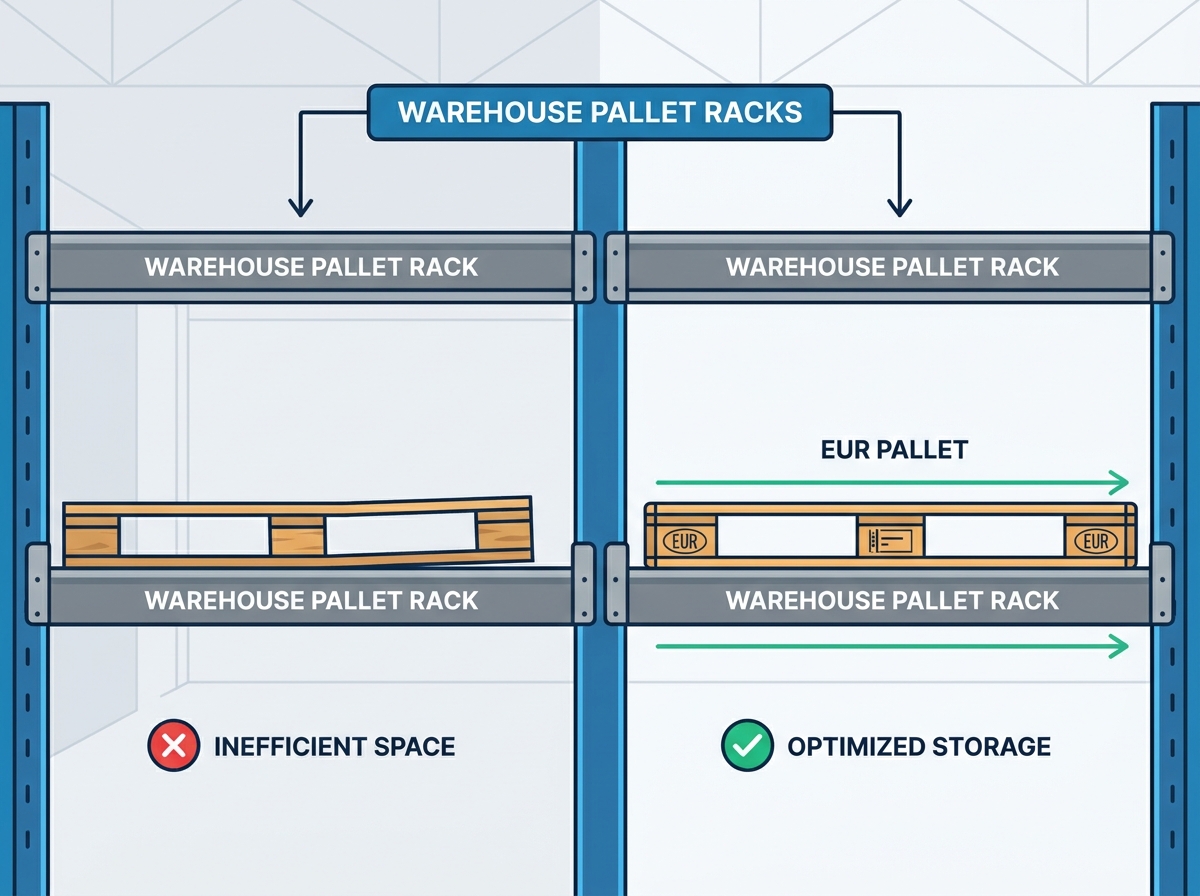
The structural anatomy of an EPAL 1 pallet ensures high load-bearing capacity. Construction includes exactly 78 special nails driven in a prescribed pattern to fasten 11 boards and 9 solid wood blocks. The top deck consists of five boards of varying widths (three 145 mm boards and two 100 mm boards) spaced precisely to support heavy point loads. Below the blocks, three bottom runners (skids) provide the base. The direction of these bottom runners dictates how the pallet must sit on a warehouse pallet rack. Runners must run perpendicular to the load beams to distribute weight safely and prevent the pallet from falling through the rack structure.
While the standard Euro pallet is the most common, the EPAL family includes several variations designed for specific logistical needs. Facility engineers must account for these variations when designing mixed-use storage zones.
| EPAL Type | Dimensions (mm) | Primary Application | Safe Working Load (kg) |
|---|---|---|---|
| EPAL 1 | 1200 x 800 | Standard retail and FMCG logistics | 1500 |
| EPAL 2 | 1200 x 1000 | Heavy industrial and chemical transport | 1470 |
| EPAL 3 | 1000 x 1200 | Asian market compatibility | 1500 |
| EPAL 6 | 800 x 600 | Display and half-pallet retail loads | 750 |
Mixed pallet types require adaptable storage configurations to prevent load imbalance. Storing an EPAL 6 alongside an EPAL 1 on the same beam level requires heavy-duty wire decking or specialized steel support bars. You cannot rely on standard step beams alone when handling half-pallets, as the span between the front and rear beams exceeds the depth of the pallet itself.
EPAL certification guarantees quality-assured manufacturing. The official EPAL stamp on the corner blocks indicates the pallet meets strict wood moisture content limits (maximum 22%) and phytosanitary treatment standards (ISPM 15). Counterfeit or non-compliant pallets compromise the safety of a storage system. A substandard pallet will deflect excessively under load, potentially snapping mid-air while a forklift operator attempts to place it on a high-level beam.
The uniform dimensions of Euro pallets facilitate seamless, multi-modal transport across rail, road, and automated warehouse systems. Supply chain standardization allows logistics providers to maximize trailer space and reduce transit times. Standard European truck trailers measure 2.4 meters internally. This width perfectly accommodates three 800 mm wide EPAL 1 pallets placed side-by-side, or two 1200 mm long pallets placed end-to-end. When pallets fit perfectly into the transport vehicle, companies eliminate dead space and optimize freight efficiency.
The EPAL open-pool exchange system offers significant operational advantages. Shippers can exchange empty pallets for loaded ones at delivery points. This system eliminates empty pallet transport logistics and simplifies international trade. Companies avoid the expense of purchasing new pallets for every shipment, relying instead on a circulating pool of standardized assets. The exchange pool operates on a strict quality classification system, ensuring that damaged pallets are repaired by certified facilities rather than discarded.
High structural durability ensures longevity within high-density European pallet racking systems. Standardized wood moisture content prevents warping and fungal growth, which is critical for food-grade storage facilities. The rigorous fastener pattern prevents wood splitting during rough forklift handling. This durability reduces debris in the warehouse. Broken wood shards and loose nails cause severe problems in automated facilities, often jamming conveyor rollers or puncturing forklift tires. Maintaining a fleet of certified EPAL pallets directly reduces facility maintenance downtime.
Furthermore, the chamfered bottom boards of the EPAL pallet assist in smooth material handling. The angled edges allow pallet jacks and forklift tines to enter the pallet smoothly without splintering the outer boards. This small design detail significantly extends the lifespan of the pallet and reduces the physical strain on manual handling equipment.
Comparing the 1200 x 800 mm Euro pallet against the 48" x 40" (1219 x 1016 mm) US standard pallet reveals significant dimensional trade-offs. Racking engineers face metric-to-imperial translation challenges when designing facilities that handle both standards. A beam length optimized for US pallets often leaves inefficient gaps when loaded with Euro pallets. Conversely, a bay designed strictly for Euro pallets will physically reject a standard US pallet.
| Feature | European Pallet (EPAL 1) | US Standard Pallet (GMA) |
|---|---|---|
| Dimensions | 1200 mm x 800 mm (47.2" x 31.5") | 1219 mm x 1016 mm (48" x 40") |
| Standard Beam Length (3 Pallets) | 2700 mm (106.3") | Not applicable (typically 2 pallets per 96" beam) |
| Standard Frame Depth | 1000 mm or 1050 mm | 42 inches (1066 mm) |
| Entry Type | 4-way entry | 4-way entry (notched stringers) |
These dimensional differences impact ISO ocean container loading patterns. Standard 20ft or 40ft shipping containers are optimized for the US footprint. Shipping Euro pallets in these containers results in noticeable efficiency loss. The 800 mm width leaves awkward voids that require extensive dunnage, airbags, or blocking and bracing to secure the load. If you do not secure these voids, the pallets will shift during ocean transit, leading to crushed cargo and unsafe unloading conditions at the destination port.
Cross-border storage friction occurs when an international facility receives mixed pallet standards. Operational bottlenecks emerge when forklifts attempt to place Euro pallets into racks designed strictly for US dimensions. A standard US rack frame is 42 inches deep. A Euro pallet is 47.2 inches deep. While it spans the beams, the 800 mm width means that if the forklift operator is slightly off-center, the pallet can slip off the beam. Facilities handling global freight require adaptable storage systems, such as universal wire decking or drop-in crossbars, to maintain throughput without compromising safety.
Sizing storage infrastructure for EPAL requires specific beam length and frame depth evaluations. The industry standard for housing three Euro pallets side-by-side is a 2700 mm beam. This length accommodates three 800 mm wide pallets (2400 mm total) while providing the necessary 100 mm clearances between pallets and upright frames. You need 100 mm between the left upright and the first pallet, 100 mm between the first and second pallet, 100 mm between the second and third pallet, and 100 mm between the third pallet and the right upright. Optimal frame depths typically measure 1000 mm or 1050 mm. This allows the 1200 mm deep pallet to overhang the front and back beams evenly by 75 mm to 100 mm, ensuring the load transfers directly through the strongest part of the pallet blocks onto the steel beams.
Load distribution and weight capacity planning dictate structural safety. If storing three 1,500 kg Euro pallets, the beam pair must safely support a minimum of 4,500 kg uniformly distributed load (UDL). Engineers must factor in acceptable deflection limits, typically L/200 or L/300. For a 2700 mm beam, an L/200 deflection limit means the beam can safely bow downward by 13.5 mm under full load. Once the forklift removes the pallets, the steel must return to its original horizontal state. If it does not, the beam has experienced plastic deformation and must be replaced immediately.
The three bottom runners of the Euro pallet must sit perpendicular to the racking beams. Loading them parallel introduces severe structural risks. If loaded parallel, the pallet only makes contact with the beams at a few small points, or worse, slips entirely between the front and rear beams. To mitigate these risks in mixed-use facilities, operations managers configure warehouse pallet racks with pallet support bars. Two flanged support bars per pallet position provide a rigid secondary support structure.
Retrofitting current US-standard racks for Euro pallets is feasible but requires careful assessment. Adding safety accessories prevents pallets from falling through mismatched frame depths. Facilities can install heavy-duty wire decks with a tight mesh pattern (e.g., 50 mm x 100 mm) to bridge the gap. You must ensure the wire deck capacity matches the point load of the Euro pallet's bottom runners. Standard wire decks are rated for uniformly distributed loads, not the concentrated line loads produced by EPAL skids.
Selective pallet racking serves as the baseline solution for operations requiring 100% SKU accessibility. This configuration offers an excellent cost-to-benefit ratio for fast-moving consumer goods (FMCG) stored on Euro pallets. Forklift operators can access any single pallet without moving others, maximizing picking speed in high-turnover environments. A standard selective bay configured with 2700 mm beams and 1000 mm deep frames provides the most versatile storage environment for standard EPAL 1 inventory.
High-density storage alternatives maximize cubic space utilization for bulk goods. When SKU counts are low but pallet volumes are high, selective racking wastes too much floor space on forklift aisles. You must evaluate denser configurations based on your specific inventory rotation requirements.
Drive-In Racking: Euro pallet dimensions fit efficiently within drive-in lanes, provided the rail spacing matches the 800 mm or 1200 mm entry face. Careful engineering ensures forklift masts clear the uprights while pallets rest securely on the support rails. You must specify whether you are driving in on the 800 mm face or the 1200 mm face, as this dictates the entire structural layout of the drive-in block.
Pallet Flow Racking: The bottom deck board orientation of the Euro pallet dictates the type of rollers required. Because the three runners run along the 1200 mm length, pallet flow lanes must use full-width cylindrical rollers rather than skate wheels. Skate wheels can catch on the bottom boards or fall into the gaps between the runners, causing the pallet to stall mid-lane.
Push-Back Racking: Push-back systems utilizing nested steel carts work exceptionally well with Euro pallets. The carts provide a flat, solid surface that supports the pallet regardless of runner orientation, eliminating the point-load issues associated with standard step beams.
Integrating Euro pallets into automated storage and retrieval systems (AS/RS) demands strict deflection and dimensional tolerances. Automated cranes and shuttles operate with millimeter precision. Even a 5 mm variance in beam deflection or pallet overhang can trigger system faults, causing costly operational downtime. AS/RS facilities often require EPAL pallets to pass through a profile checking station before entering the rack structure. This automated scanner verifies the pallet dimensions, checks for broken boards, and ensures the load does not exceed the maximum allowable height or width.
Under-specifying beam capacities leads to permanent plastic deformation of the steel and potential structural collapse. Deflection limits must account for the dynamic forces applied when a forklift places a heavy Euro pallet onto the beam. Engineers must calculate for maximum potential loads rather than average loads. If your average pallet weighs 800 kg, but your maximum pallet weighs 1200 kg, you must engineer the entire system to handle the 1200 kg maximum. Failing to do so invites catastrophic failure during peak seasonal inventory surges.
Material handling equipment (MHE) compatibility directly influences aisle width planning. The specific 4-way entry points of the Euro pallet determine how forklifts engage the load. Narrow-aisle (VNA) forklifts require precise floor guidance and exact pallet placement to handle EPAL footprints safely at high elevations. The fork tines must align perfectly with the 227 mm wide entry windows on the 800 mm face of the pallet. If the tines are too thick or spaced incorrectly, they will smash into the wooden blocks, destroying the pallet and destabilizing the load.
Mitigating structural failure risks requires partnering with a certified pallet racking manufacturer. Vetting manufacturers involves verifying their capability to provide site-specific seismic engineering and load application calculations. Ensure the manufacturer complies with global safety standards, such as RMI in the US, EN 15512 in Europe, or FEM regulations. A qualified manufacturer will provide detailed CAD drawings showing exact clearances, beam elevations, and baseplate anchoring requirements tailored specifically to the EPAL footprint.
Floor slab capacity is another critical risk factor. High-density European racking systems concentrate massive amounts of weight onto small baseplates. A standard 6-inch concrete slab may not support the point loads generated by a 10-meter high drive-in system fully loaded with 1500 kg Euro pallets. You must conduct a core sample test of your concrete floor before finalizing any high-density rack design.
Conduct a facility-wide pallet audit to identify the exact percentage of Euro pallets versus US standard pallets currently moving through your receiving docks.
Measure your existing beam lengths and frame depths to determine if your current infrastructure safely supports the 1200 mm x 800 mm footprint without excessive overhang.
Install heavy-duty flanged pallet support bars or custom-fitted wire decking immediately if Euro pallets are currently stored on racks with mismatched 42-inch frame depths.
Consult with a certified structural engineer to calculate current beam deflection under maximum load conditions.
Request site-specific CAD layouts from a certified racking manufacturer to design a compliant, optimized layout before expanding your storage capacity.
A: The standard EPAL 1 European pallet measures 1200 mm in length, 800 mm in width, and 144 mm in height. In imperial units, this translates to approximately 47.2 inches by 31.5 inches by 5.7 inches. It features a specific 9-block and 3-runner construction.
A: EPAL 1 is the standard 1200 x 800 mm pallet used for general logistics. EPAL 2 is a heavier industrial pallet measuring 1200 x 1000 mm. EPAL 3 measures 1000 x 1200 mm. Each serves different load distribution and regional transport requirements.
A: Storing Euro pallets on standard US racks requires caution. Because US frames are typically 42 inches deep, the 1200 mm deep Euro pallet fits, but the narrow 800 mm width requires specific beam lengths or wire decking to prevent the pallet from falling between the beams.
A: A standard EPAL 1 pallet has a safe working load of 1,500 kg when the load is uniformly distributed across the surface. It can support up to 4,000 kg when stacked statically on a solid, even concrete floor.
A: Configure selective racks with 2700 mm beam lengths to hold exactly three Euro pallets side-by-side. Use frame depths of 1000 mm or 1050 mm to allow proper front and rear overhang, and ensure beams are rated for the combined weight of three fully loaded pallets.
A: The bottom runners must sit perpendicular to the racking beams. If placed parallel, the pallet lacks structural support across the span and can easily slip between the front and rear beams, leading to product damage and severe safety hazards.


