Phone / Whatsapp:+8615618993196

Views: 0 Author: Site Editor Publish Time: 2026-07-29 Origin: Site


In small apartments, square footage is a premium asset. Static, heavy-duty equipment creates permanent spatial bottlenecks that degrade livability. Consumers struggle to find high-capacity shelving or fitness racks that offer commercial-grade stability during use but can be collapsed to reclaim floor space. Many space-saving options sacrifice structural integrity and safety for convenience, leaving residents with flimsy units that buckle under heavy loads or wobble dangerously during workouts.
This guide provides a technical evaluation framework for selecting a foldable rack, segmenting the market into heavy-duty household storage and compact fitness solutions. By analyzing load capacities, material gauges, and folding mechanisms, you can ensure your investment aligns with your specific load requirements, ceiling heights, and spatial constraints without compromising safety.
Application Dictates Engineering: A foldable rack designed for fitness requires 11-to-14-gauge steel and wall-stud anchoring, whereas a foldable household shelf prioritizes caster mobility and multi-tier load distribution.
Dimensional Constraints Go Beyond Footprint: Wall length and ceiling clearance (specifically the vertical pivot arc during folding) are just as critical as floor space when deploying a foldable system.
Material Integrity Matters: Angle steel rack constructions offer superior rigidity for static loads, while tubular steel remains the standard for dynamic fitness applications.
Installation Realities: Wall-mounted folding racks require precise 16-inch or 24-inch stud spacing and permanent drilling, which may present compliance issues for apartment renters.
Vendor Accountability: Evaluating a home storage rack supplier based on warranty terms, structural testing data, ease of solo assembly, and replacement part availability is critical for long-term ROI.
Establishing what makes a foldable unit viable in a highly constrained residential environment requires looking past basic dimensions. A successful unit must reduce its depth to under 10 inches when stowed and fit comfortably within limited wall lengths. Calculating the true space savings means measuring both the deployment footprint and the stowed footprint. If a unit takes up too much room when collapsed, it fails its primary objective. You have to measure the exact floor space you are willing to sacrifice permanently.
Ceiling height plays a massive role in functionality. Many folding systems pivot upward or swing inward. This requires an overhead clearance arc that can easily collide with low ceilings, ceiling fans, or sprinkler lines. You must measure the maximum height the frame reaches mid-fold, not just its resting height. A standard 8-foot ceiling might seem sufficient until you realize the upward swing of a 90-inch upright requires 9.5 feet of clearance during the folding process.
Maximizing functional space involves understanding the working inside depth versus the overall structural depth. For fitness applications, this means checking the interior barbell clearance. A unit might have a 26-inch inside depth but a 30-inch external footprint. For storage, evaluate shelf accessibility relative to the total volume the unit occupies. You want maximum usable shelf space with minimal frame intrusion.
| Metric | Storage Application Focus | Fitness Application Focus |
|---|---|---|
| Stowed Depth | Under 5 inches (flat fold) | Under 10 inches (wall-hugging) |
| Vertical Clearance | Static height only | Requires pivot arc clearance |
| Load Distribution | Multi-tier static weight | Dynamic kinetic force absorption |
| Floor Contact | Casters or leveling feet | Rubberized flat footplates |
Evaluating the maximum weight capacity against the unit's own mass reveals its true stability. Heavy racks are inherently stable but can be difficult to fold and maneuver. Lightweight racks are easy to stow but prone to structural failure under heavy loads. You must find the balance that supports your specific use case. Moving parts are the primary points of failure in any foldable system. Assessing the hinge points, locking pins, and gas shocks is necessary to ensure long-term reliability. Look for solid steel pins rather than hollow tubes.
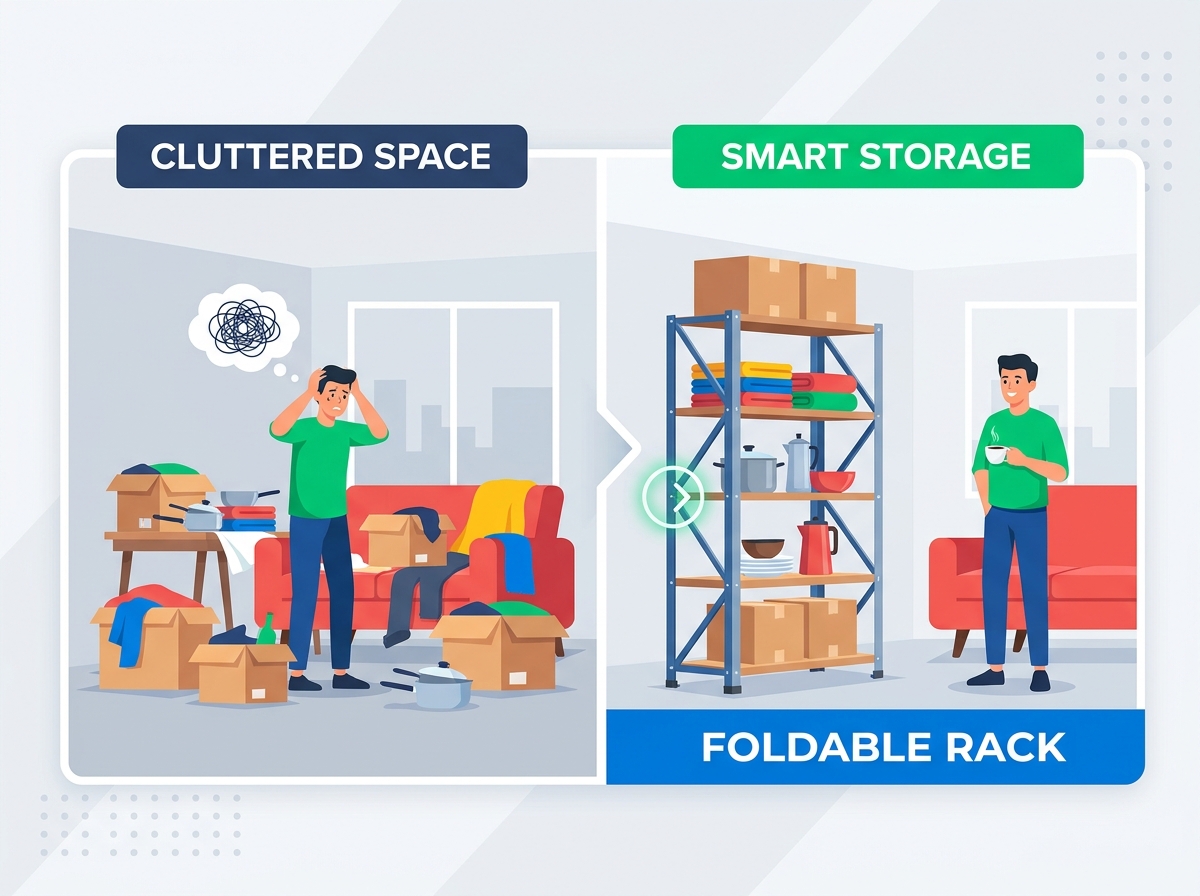
When analyzing foldable racks built specifically for inventory, pantry, and utility storage, the engineering focus shifts toward multi-tier weight distribution and mobility. A reliable household shelf must handle static loads safely while remaining easy to reposition. You are dealing with dead weight, which means the vertical uprights take the brunt of the force.
Evaluating multi-tier folding racks for kitchen appliances and bulk dry goods requires a close look at assembly complexity and base support. Pre-assembled, tool-free folding kitchen storage rack options offer a significant advantage over multi-part hardware kits, eliminating the risk of stripped screws and misaligned brackets during setup. You unbox it, pull the sides apart, and lock the shelves into place.
There is an inherent trade-off between locking caster wheels and adjustable leveling feet. Casters provide mobility for easy cleaning and layout changes. Leveling feet offer maximum stability on uneven apartment floors. Weight distribution requirements dictate that the bottom tier must support heavy appliances, such as microwaves or stand mixers, without warping the folding mechanism over time. Always load the heaviest items on the bottom shelf to lower the center of gravity.
Unbox the unit and lay it flat on the floor to inspect all hinge joints.
Stand the frame upright and pull the side panels outward until the main shelves drop into position.
Engage the rear locking latch to secure the frame's rigidity.
Install either the caster wheels or leveling feet depending on your flooring type.
Test the stability by applying downward pressure on the top shelf before loading items.
An angle steel rack is the preferred choice for heavy-duty, static household storage due to its inherent rigidity. The L-shaped profile of the steel resists bending under heavy localized loads much better than flat or thin tubular metal. This shape provides structural integrity without adding excessive bulk to the frame.
Comparing bolted angle steel hinges versus riveted folding mechanisms reveals differences in long-term stability. Bolted joints allow for tightening if the rack loosens over time, whereas rivets can stretch and introduce permanent wobble. Evaluating weight capacities per tier helps determine the risk of metal fatigue over repeated folding cycles. A shelf rated for 250 lbs per tier will outlast a 100 lb rated shelf even if you only load 50 lbs on it, simply due to the thicker material.
Transitioning to dynamic load-bearing racks, such as squat racks and power racks designed for apartment workouts, introduces entirely different structural requirements. These units must absorb kinetic energy and lateral force. Dropping a barbell creates shockwaves that a static storage shelf never experiences.
Wall-mounted systems maximize floor space by folding flat against the drywall. However, they require stringer boards to bridge non-standard apartment wall studs and support heavy lateral loads safely. This permanent modification is highly stable but requires drilling into the wall framing. You cannot mount these directly to drywall or metal studs without severe risk of failure.
Freestanding foldable systems do not require wall drilling, making them renter-friendly. They support quick disassembly for temporary workout areas. The trade-off is a typically larger stowed footprint and lower lateral stability during dynamic movements like pull-ups or heavy racking. You will experience more side-to-side sway with a freestanding unit.
Understanding why 3x3-inch, 11-gauge steel is the gold standard for dynamic fitness loads is necessary. It provides maximum rigidity and safety for heavy lifting. Conversely, 2x3-inch 14-gauge steel serves as a lighter, budget-friendly compromise that works well for tight spaces and moderate weight loads. The thicker the steel, the less the rack will flex under load.
| Steel Gauge | Tubing Size | Best Use Case | Lateral Stability |
|---|---|---|---|
| 11-Gauge | 3x3 inch | Heavy lifting, pull-ups | Excellent |
| 12-Gauge | 2x3 inch | Moderate lifting | Good |
| 14-Gauge | 2x2 inch | Light fitness, tight spaces | Fair |
Assessing J-cup weight ratings and pull-up bar height adjustments ensures the rack meets your training needs. The inclusion of UHMW plastic on contact points protects the rack's finish and prevents damage to apartment walls during folding. For narrow-space engineering, evaluate options designed specifically for tight wall lengths or corner placements, ensuring the uprights do not block walkways when collapsed.
Moving beyond the spec sheet to evaluate the manufacturer's credentials protects your investment. You need to know if the home storage rack supplier provides actual static and dynamic load testing data, or if they rely on arbitrary maximum weight claims. Real testing data shows how the rack performs under stress, not just how much dead weight it can hold before snapping.
Assessing the logistical reality of receiving and building a heavy steel rack is vital. Check if the supplier provides clear, step-by-step video guides and verify if the unit can be assembled by a single person. Modularity is another key factor. Determine if the system can be upgraded with attachments, such as dip stations for gym racks or extra tiers and pegboards for storage racks. A good ecosystem extends the life of your purchase.
Utilizing peer reviews, enthusiast forums, and real-world durability feedback helps verify the manufacturer’s structural claims. A reputable supplier will have a track record of honoring warranties and providing replacement parts for wearable components like locking pins and gas shocks. If you cannot buy a replacement hinge pin, the entire rack becomes useless when that single part fails.
Addressing the physical realities of installing heavy foldable equipment in rentals prevents costly damage and lease violations. Mitigating drywall damage requires using properly routed stringer boards to distribute weight across multiple wall studs. You must understand your lease agreements regarding structural wall modifications and temporary installations before drilling. Patching a few lag bolt holes is standard; ripping down a sheet of drywall because you missed the stud is a lost security deposit.
Preventing damage to apartment flooring from heavy caster wheels or metal uprights is non-negotiable. High-density EVA foam or horse stall mats are necessary to protect the subfloor and dampen noise. Uneven flooring can cause folding mechanisms to bind or lock up. Utilize shims, adjustable feet, or specialized hinge pins to ensure smooth operation regardless of floor variations. If the rack is not perfectly level, the hinges will fight each other during the folding process.
Measure your exact available wall space, including baseboard depth and ceiling height, to determine your maximum deployment footprint.
Locate your wall studs using a high-quality magnetic stud finder to confirm spacing before ordering any wall-mounted system.
Audit your specific load-bearing requirements, separating static storage needs from dynamic fitness needs.
Contact your landlord or review your lease agreement to confirm if drilling into wall studs is permitted for heavy equipment installation.
A: Weight capacities vary significantly based on construction. Always check the per-tier limits versus the total unit limits. A standard heavy-duty shelf typically holds between 250 lbs and 400 lbs per tier, resulting in a total unit capacity ranging from 1000 lbs to over 1500 lbs when weight is evenly distributed across all shelves.
A: The vertical pivot arc during folding dictates the minimum clearance. Systems that fold upward usually require at least 8 to 9.5 feet of ceiling clearance. Always measure the highest point the rack reaches mid-swing, not just its deployed height, to avoid hitting the ceiling.
A: Yes, but it requires caution and proper hardware. You must use stringer boards anchored into the wall studs with heavy-duty lag bolts to distribute the load safely. Always review your lease agreement regarding wall modifications, as you will need to patch and paint the holes upon moving out.
A: Hard plastic or bare metal casters can scratch and dent hardwood floors under heavy loads. Look for racks equipped with polyurethane or rubberized locking casters, or place the unit on a protective mat to prevent floor damage when moving the rack.
A: Regularly inspect locking pins, hinges, and gas shocks for wear. Keep moving parts free of dust and apply a dry silicone lubricant to hinges every few months to prevent binding and ensure smooth operation. Avoid wet lubricants that attract dirt.
A: Most freestanding foldable racks are designed to operate without floor bolting, relying on their wide base and heavy steel construction for stability. However, if you are performing heavy dynamic movements like kipping pull-ups, adding weight plates to the base pegs will increase stability.


